The Collagen Decline Timeline: What's Happening in Your Body From Age 25 Onwards
Nothing dramatic happens on your 25th birthday. That is exactly the problem. Somewhere around your mid-twenties, your body quietly turns down its own collagen production - and because it is gradual, most people do not notice until the effects have had a decade-long head start.
Collagen is the structural protein that holds you together: it is the scaffolding in your skin, the cushioning in your joints, the resilience in your tendons and ligaments. While you are young, your body makes plenty of it and replaces it constantly. That changes - and the timeline is worth understanding, because you cannot manage what you cannot see.
What collagen actually does
It helps to picture the job before the decline. Collagen is the most abundant protein in the body and the main structural component of connective tissue. In skin, it forms the deep scaffold that keeps the surface firm, smooth and elastic. In joints, it is a key part of the cartilage and connective tissue that cushion movement. In tendons and ligaments, it provides the tensile resilience that lets tissue stretch and recover. When production is healthy, this scaffolding is constantly maintained and replaced. When production slows, maintenance falls behind demand.
The decline curve, decade by decade
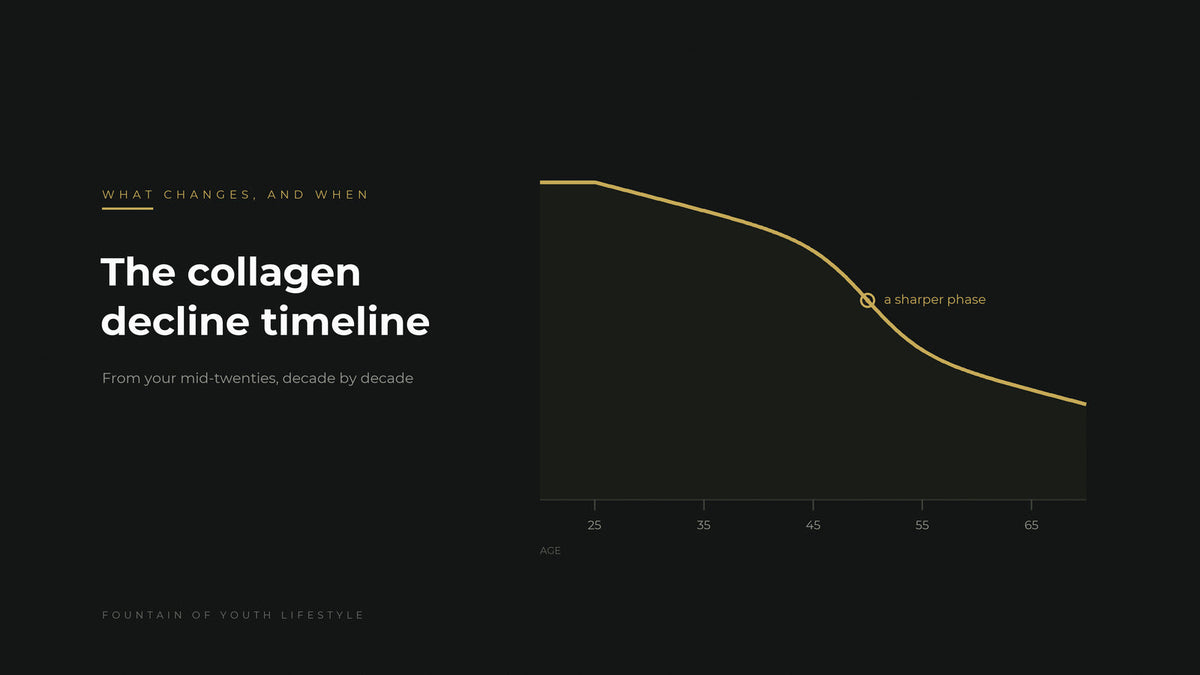
From your mid-twenties. Natural collagen production begins a slow, steady decline. It is widely described as dropping by roughly one percent or so each year. You will not feel year one. You will feel year ten.
Thirties. The cumulative effect starts to show up where collagen is doing visible structural work - skin firmness and elasticity, the "bounce" of recovery after effort, the ease of joints first thing in the morning.
Forties and around menopause. For women, the menopausal transition is associated with a sharper, faster phase of collagen loss in a relatively short window. This is when the gradual slope can feel like a step change, because the rate of loss picks up rather than holding steady.

None of this is a disease. It is normal biology. But "normal" does not mean "nothing you can do about your collagen intake."
The cumulative maths most people miss
The reason the decline sneaks up on people is that small annual losses compound. A barely-noticeable drop each year, repeated across a decade, adds up to a meaningful change in the structural protein your skin and joints depend on. By the time the effect is obvious in the mirror or in your morning stiffness, it has been quietly accumulating for years. Gradual is not the same as small - it just feels that way day to day.

Where you feel it
- Skin: firmness, elasticity, and that smooth, supported quality are all collagen-dependent.
- Joints: cartilage and joint cushioning rely on collagen-rich connective tissue.
- Tendons and ligaments: the resilience and recovery of connective tissue is structural collagen at work.
The common thread is that these are all Type I collagen-dependent systems. They decline together, which is why "skin" and "joints" are not really two separate conversations - they are the same scaffolding, in different places.

Why the form of what you replace it with matters
If you are going to top up collagen as your own production slows, the obvious question is whether what you take is in a usable form. This is where most collagen falls down: large, mixed-size hydrolysate leaves your body to do the breaking-down, with an unpredictable result. Topping up a declining system with a hard-to-use form is a strange way to spend money.
Topping up with the smallest functional form
FoYL is a pure bovine collagen tripeptide - collagen reduced to three-amino-acid chains at 300 to 500 Daltons, more than 80% in true tripeptide form. Independently analysed by the University of Milan, Department of Pharmaceutical Sciences (2025), its modelled profile predicted around five times higher total bioactivity than conventional ~2,000 Dalton collagen. (Laboratory modelling of the peptide profile, not a clinical or anti-ageing claim.)

The point of acting earlier
The decline is gradual and cumulative, which cuts both ways. The earlier you start treating collagen intake as a daily habit, the longer that habit has to compound - in exactly the way the decline does, just in your favour. There is no magic birthday for starting. The best one is "before you have been wondering about it for ten years."
Common questions
Is it too late to start in my forties or fifties? No. The decline is ongoing, so supporting your collagen intake is relevant at any age. The "earlier is better" point is about compounding, not a cut-off.
Will collagen reverse ageing? We do not make that claim, and you should be wary of anyone who does. What we can speak to is the quality and usable form of the collagen you choose to top up with.
How much should I take? FoYL's recommended daily dose is 2.5g, with a lighter 1g maintenance option. Consistency over weeks matters more than any single serving.
If you want to understand the molecular side properly, our science page lays out how the tripeptide was tested and what the figures mean.
Your collagen has been declining since your mid-twenties. Start topping it up properly.
P.S. The decline does not send a reminder. The habit is the reminder. The best day to start a daily collagen habit was ten years ago; the second best is the next time you boil the kettle.